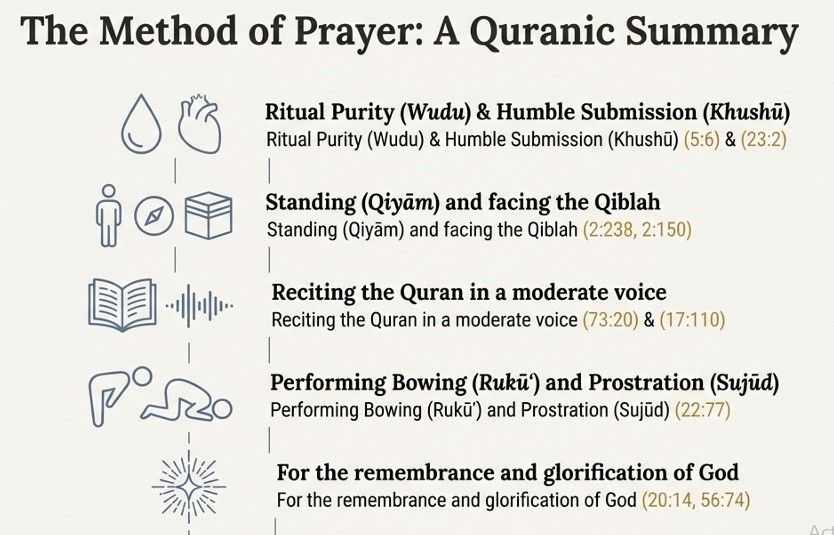
How to Pray Namaz (Salah) from the Quran: A Complete Namaz in English
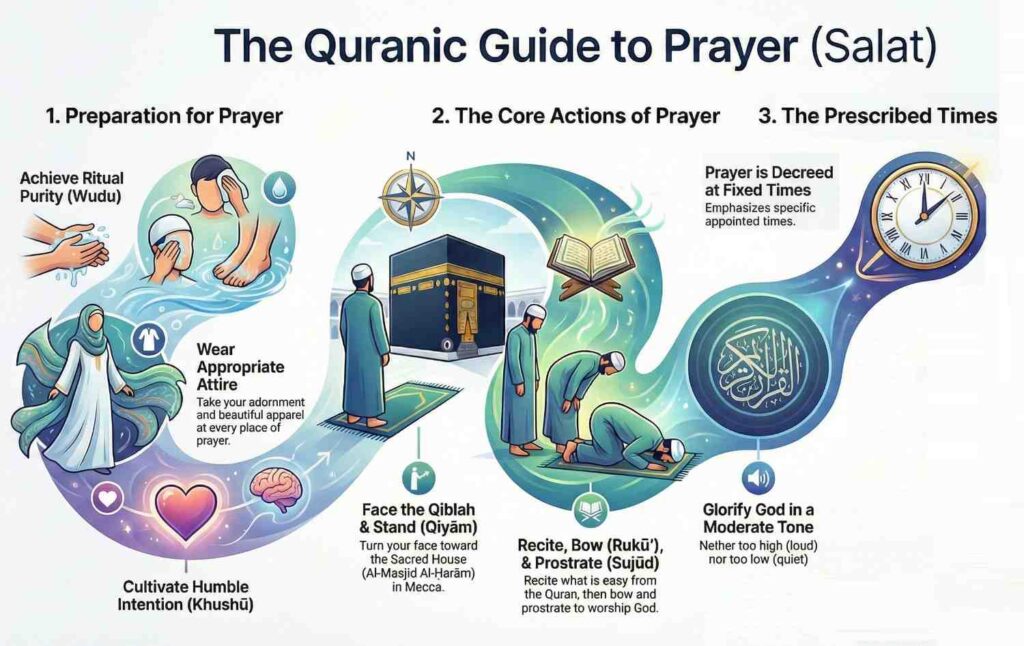
Salah – Islamic prayer, here is how to pray namaz in the light of the Quran, based only on the verses of the Quran.
How to Pray Namaz (Salah)
Part One: Preparing for Prayer
There are a few essential things that must be completed before starting Sunnah namaz:
Cleansing (Wudhu)
It is necessary to cleanse the body and purify yourself before standing up for EVERY prayer. Before you start praying, perform ablution:
💧🤲🚿
- “O you who have believed! When you rise up for prayer, wash your faces and your hands up to the elbows, and wipe over your heads, and wash your feet up to the ankles.” (Quran 5:6)
If you need to take a bath, then take a bath and purify yourself.
After sexual intercourse, it is necessary to take a bath for prayer (Quran 4:43).
Clothing: Wear clean and appropriate clothing when praying:
“O children of Adam! Wear your best clothing at every prayer…” (Quran 7:31)
Intention and Dhikr
Pray with full attention and heart, because its purpose is to remember Allah:
Quran 20:14
🕋
“..and establish prayer for My remembrance”.
Quran 23:1-2
🤲
“…and establish prayer for My remembrance.” (Quran 20:14)
(Quran 23:1-2)
Part Two: Important Tasks of Prayer
The following movements and things are mentioned in the Holy Quran during prayer:
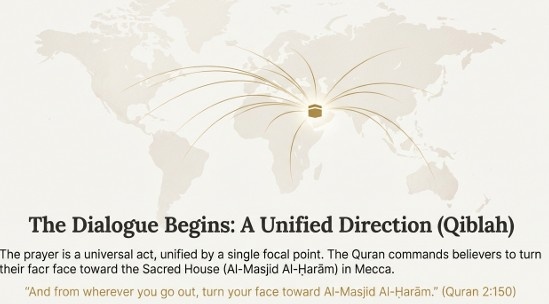
1. Facing the Qiblah
You should always face the Kaaba (the Sacred Mosque) in prayer:
“And wherever you go out, turn your face towards the Sacred Mosque.” (Quran 2:150)
2. Standing
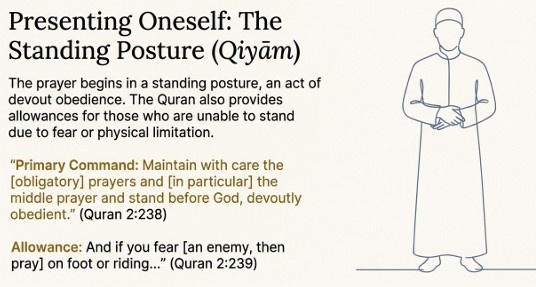
Prayer begins by standing:
- “And stand before Allah with humility.” (Quran 2:238) If there is fear or compulsion, one may pray while walking or riding (Quran 2:239).
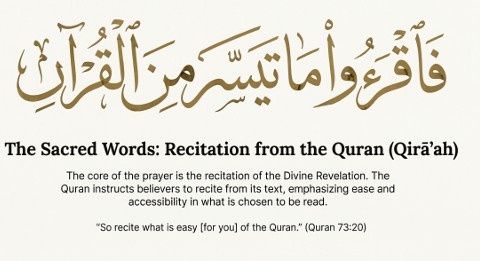
3. Reciting the Quran
An important part of prayer is reciting verses of the Quran:
- “So recite what you can of the Quran with ease.” (Quran 73:20). You can read ANYTHING from Quran, there is no complusion.
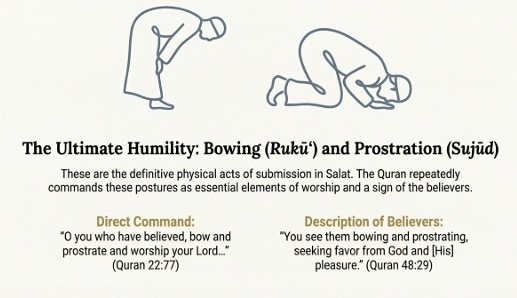
4. Bowing and prostrating (Ruku’ and Sajdah)
These are essential physical acts of prayer:
- “O you who have believed! Bow down and prostrate yourselves and worship your Lord…” (Quran 22:77) “And bow down with those who bow down.” (Quran 2:43)
5. Praise and remembrance of Allah
Prayer is to glorify and remember Allah from the heart:
- “So glorify the name of your Lord, the Great.” (Quran 56:74) “Glorify the name of your Lord, the Most High.” (Quran 87:1)
6. Mode of voice
While praying, the voice should be neither too loud nor too soft, but in between:
- “And do not be too loud in your prayer, nor too soft, but adopt a middle way between it.” (Quran 17:110)
Part Three: Namaz prayer Times
The Quran states that prayer is obligatory at fixed times:
- “Indeed, prayer is prescribed for the believers at fixed times.” (Quran 4:103)
Indications of times
- “…and the recitation of the Quran at dawn. Indeed, the recitation of the Quran at dawn is a time of attendance.” (Quran 17:78, part)
- “And establish prayer at the two ends of the day and at certain parts of the night. Indeed, good deeds repel evil deeds. This is a reminder for those who receive admonition.” (Quran 11:114)
- “Establish prayer from the setting of the sun until the darkness of the night…” (Quran 17:78, part)
Questions and Answers
Q1: Is prayer limited to specific times?
Yes. “Indeed, prayer is prescribed for the believers at fixed times.” (Quran 4:103)
Q2: What is the indication for the Morning (Fajr) prayer time?
The time is indicated as “at dawn” and the “two ends of the day.” (Quran 17:78, 11:114)
Q3: What are the other general time indications mentioned?
Other times include “from the setting of the sun until the darkness of the night” and “at certain parts of the night.” (Quran 17:78, 11:114)
Q4: How does the provided guide ensure prayer is based solely on the Quran and avoids sectarian divisions?
The guide explicitly states that its purpose is to outline the way to pray “based only on the verses of the Quran.” It focuses strictly on the Quranic mandates for prayer, such as Wudhu (Quran 5:6), wearing clean clothes (Quran 7:31), facing the Qiblah (Quran 2:150), Ruku’ and Sajdah (Quran 22:77), and reciting the Quran (Quran 73:20).
By adhering only to these fundamental, universally accepted actions found in the Holy Book, the procedure aims to be a non-sectarian method of worship dedicated purely to the remembrance and glorification of Allah.